

More and more U.S. companies are discovering the appeal and opportunity of talent in emerging markets. Smart, ambitious women make up the majority of this talent pool, but time and time again, these women are being overlooked when it comes to assigning leadership positions. What does it take for emerging-market female talent to break into the executive ranks of a U.S.-based multinational company?
Makiko Eda, president of Intel Japan and VP of Sales and Marketing, points to her success driving brand awareness and profits throughout Asia-Pacific markets. But she believes her credibility derives from her ability to modify her leadership style based on cultural expectations.
“I do put on my cowboy hat at headquarters,” she says. “I’m not used to being asked for my opinion, nor to have to cut off people in order to interject it, but especially in topics where I’m assured of my expertise, I’ve learned to do it.” In Tokyo, she drops the combative style for a more respectful stance; in Korea, she adopts a reserved style in order to coax others to confide in her; and in India, where’s there’s a culture of open debate — “each of them will have to say something about everything” — she asks questions and shows a willingness to learn.
This “pivoting” among stakeholders is what our 2015 study of leaders and rising talent in 11 markets (Brazil, China, Hong Kong, India, Japan, Russia, Singapore, South Africa, Turkey, the UK, and the U.S.) reveals to be a core competency of global executives. Based on an online survey of approximately 18,000 men and women with college degree working full-time in white-collar professions, our data shows that, for both men and women, credibility derives from adapting one’s style to local norms of executive presence.
In the U.S. and the UK, for example, rising leaders should demonstrate authority, whereas with subordinates, superiors, and clients in Asia, rising leaders should demonstrate emotional intelligence. Mastery of this “double pivot” translates into measurable career traction: Those who impress top leaders are 15% more likely to be satisfied with their progression, and those who win the trust and respect of their team are 21% more likely to be satisfied with their progression.
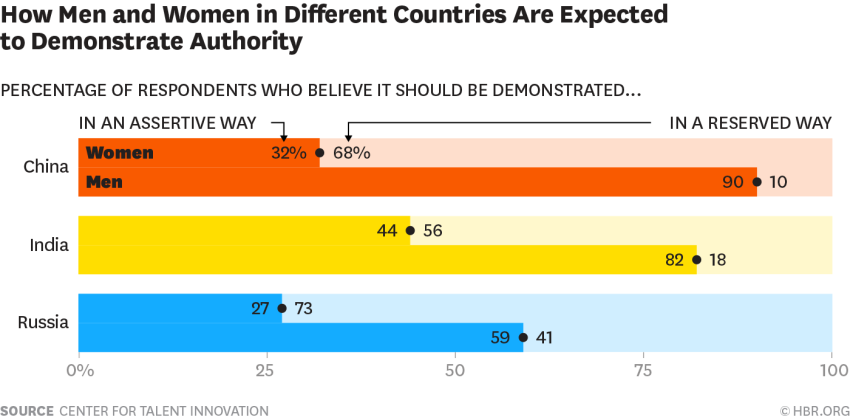
But while this double pivot positions both men and women for advancement, women have more to master. They are held, we found, to a different standard with regard to leadership norms throughout Asia. For example, much more so in Russia than in India, women are expected to demonstrate their authority in a reserved way to be seen as leaders, whereas men are expected to be assertive — particularly in China and India.
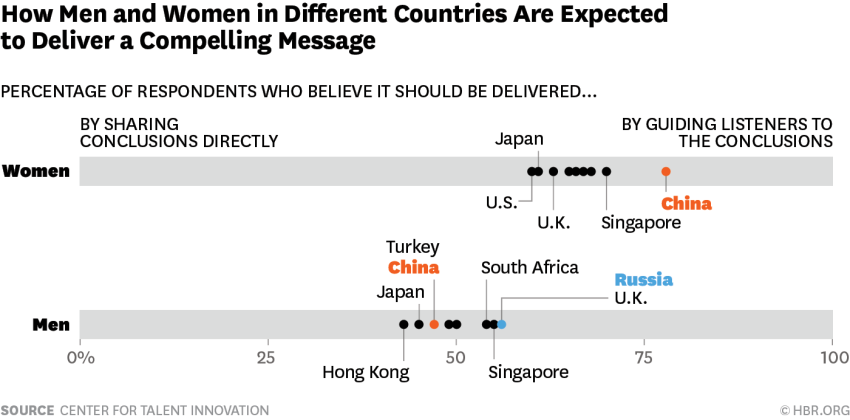
When it comes to delivering a compelling message, women in emerging markets are expected to guide rather than direct listeners to a conclusion — the reverse of what is expected of men. This expectation is marked in Japan, where 61% of respondents say women should guide listeners to a conclusion, but off the charts in China, where fully 78% say women shouldn’t be direct in stating their conclusion.
When it comes to delivering a compelling message, women in emerging markets are expected to guide rather than direct listeners to a conclusion — the reverse of what is expected of men. This expectation is marked in Japan, where 61% of respondents say women should guide listeners to a conclusion, but off the charts in China, where fully 78% say women shouldn’t be direct in stating their conclusion.
Sylvia Ann Hewlett is the founder and CEO of the Center for Talent Innovation and Hewlett Consulting Partners LLC. A Cambridge-trained economist and author of twelve critically acclaimed books, including Forget a Mentor, Find a Sponsor (Harvard Business Review Press, 2013), Hewlett has taught at Columbia and Princeton universities. In 2014, the European Diversity Awards honored her with its Global Diversity Award.
Ripa Rashid specializes in global talent strategies. She has spent over a decade as a management consultant and has held senior positions at Met Life and Time Warner. She is coauthor with Hewlett of Winning the War for Talent in Emerging Markets (Harvard Business Review Press, 2011). She is a graduate of Harvard University and INSEAD’s MBA program.
